Ask five people what “Microsoft ERP” means and you will get five answers. A controller at a 30-year-old manufacturer will say Dynamics GP. A CFO at a SaaS company will say Business Central. An IT director at a multinational will say Dynamics 365 Finance. A consultant will start explaining the difference between NAV, AX, and SL, and the conversation will lose everyone else.
All of them are right, which is the problem. Microsoft has sold ERP products for more than two decades, acquired most of them, renamed them twice, and kept several alive long after the strategic direction moved elsewhere. The result is a family with a shared logo, a shared partner channel, and almost no shared code.
This guide is about the whole family: what Microsoft sells today, what it still supports, and how a US company should think about staying, migrating, or buying new.
The Four Legacy Products Behind the Name
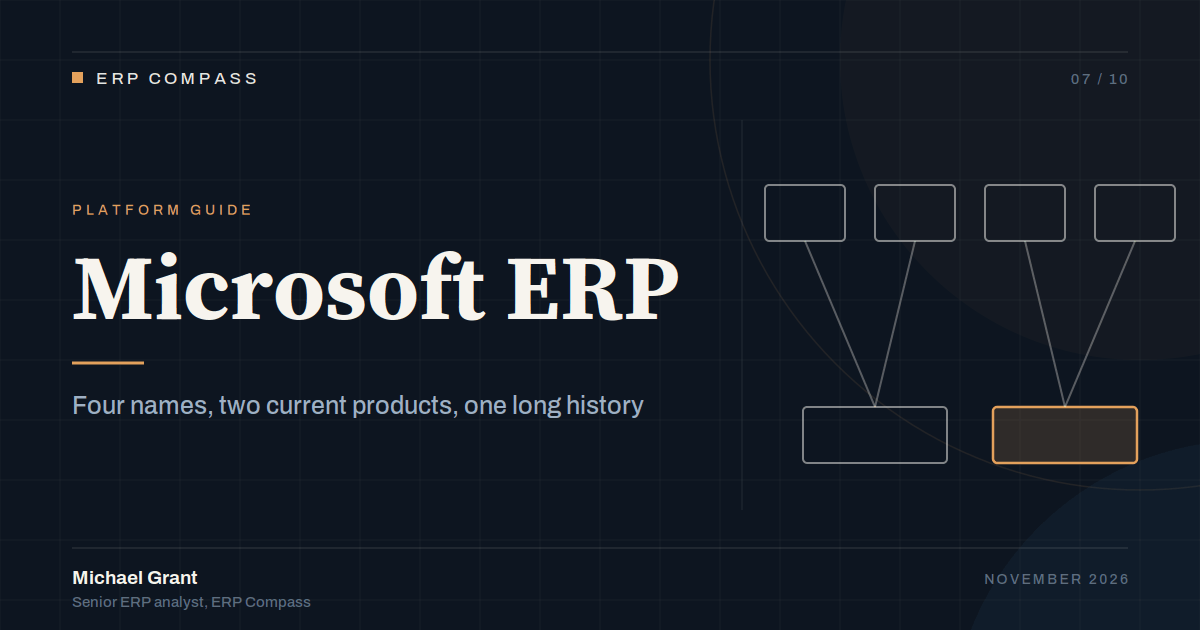
Microsoft’s ERP business was built by acquisition. The four products that matter historically are:
| Legacy product | Original company | Acquired | Became |
|---|---|---|---|
| Dynamics GP | Great Plains Software | 2001 | Still supported; no strategic successor |
| Dynamics SL | Solomon Software | 2000 | Still supported; project and services niche |
| Dynamics NAV | Navision | 2002 | Dynamics 365 Business Central |
| Dynamics AX | Axapta | 2002 | Dynamics 365 Finance and Supply Chain Management |
Great Plains and Solomon were US small-business accounting and project systems. Navision and Axapta were European mid-market ERPs with stronger manufacturing and multi-country capabilities. Microsoft bought all four within a few years, branded them as Dynamics, and then spent the next decade consolidating.
NAV became Business Central, first as “NAV 2018” and then as a cloud-first product. AX became Dynamics 365 for Finance and Operations, now split into Finance, Supply Chain Management, Commerce, and Project Operations apps. GP and SL were left on maintenance tracks with no cloud successor. That is the single most important fact for anyone running them today.
What Microsoft Sells Today
Microsoft’s current ERP lineup has two products and a platform layer.
Dynamics 365 Business Central is the mid-market product. It descends from NAV and runs in the cloud or on-premises. It covers financials, sales, purchasing, inventory, projects, and basic manufacturing. It is sold per user with Essentials and Premium tiers, and it has a large partner ecosystem with industry add-ons. It is the natural destination for most GP, SL, and NAV customers.
Dynamics 365 Finance and Supply Chain Management — often still called F&O — is the enterprise product. It descends from AX and runs as a cloud service with twice-yearly releases under Microsoft’s One Version policy. It covers financial management, procurement, manufacturing, warehouse management, transportation, and global consolidation. It is sold per user by app, with base and attach licensing. It is aimed at larger, more complex organizations than Business Central.
The platform layer is what ties Microsoft’s ERP to the rest of its stack: Power Platform for low-code apps and automation, Dataverse for data, Power BI for reporting, Azure for infrastructure, and Copilot for AI assistance. If your company already runs Microsoft 365, Entra ID, and Azure, that integration is a real advantage. It is not a reason to choose the ERP by itself, but it reduces friction.
The Lifecycle Question
If you run GP or SL, the strategic question is not whether to migrate but when. Microsoft has stopped adding major new functionality to both products and has published lifecycle dates. The exact dates matter, and they have changed before, so confirm the current support timeline with Microsoft or a partner rather than relying on a blog post.
The practical reality: GP and SL still work, and many companies run them comfortably. But the pool of consultants who know them is shrinking, third-party add-ons are aging, and new integrations increasingly assume a cloud API. The risk is not a sudden shutdown; it is a slow rise in maintenance cost and a thinning talent market. Companies usually move when an add-on breaks, a key employee retires, or a business change forces the issue.
If you run NAV, the path to Business Central is well trodden. Microsoft and partners have migration tooling, and the product is the strategic SMB platform. If you run AX, the path to Finance and Supply Chain Management is more involved: the data model and customization approach are different, and the move is a reimplementation. Some AX customers with simpler operations choose Business Central instead, which is worth evaluating honestly.
Licensing and Cost Structure
Microsoft publishes list prices, which makes budgeting easier than with Oracle or NetSuite, though partners discount and bundle. The structure is per user, per month, with different tiers.
- Business Central Essentials covers financials, sales, purchasing, inventory, and projects. It is the starting point for most SMBs.
- Business Central Premium adds manufacturing and service management. It costs more per user and is the right tier for manufacturers.
- Dynamics 365 Finance and Supply Chain Management are sold per user by app, with base and attach pricing. Enterprise agreements and volume licensing change the effective rate.
- On-premises Business Central is still available under a perpetual license, but Microsoft’s investment is in the cloud. Confirm the support and upgrade path before choosing on-premises.
As always, the subscription is not the project. Implementation, data migration, integrations, training, and internal time are separate. A Business Central deployment for a 40-user company commonly runs $30,000–$100,000 in first-year services, depending on scope and partner. F&O deployments are larger by an order of magnitude.
Who Should Choose Microsoft ERP
Microsoft ERP fits companies that want a large, stable vendor with a deep partner channel and tight integration with Microsoft 365, Power BI, and Azure. Business Central is a strong fit for US SMBs and lower mid-market companies in distribution, professional services, light manufacturing, and project-based work. F&O fits larger organizations with multi-entity operations, complex manufacturing, and a need for global consolidation.
It is a weaker fit for companies that want a single-vendor relationship with the ERP vendor doing the implementation. Microsoft sells through partners, and the quality of the partner determines the quality of the project. It is also a weaker fit for companies with highly specialized processes that require deep vertical functionality; a vertical specialist may be better.
And it is a poor fit for companies that want to avoid Microsoft’s licensing complexity. The per-user pricing is transparent, but the tier structure, base and attach rules, and partner discounts make it easy to compare the wrong numbers. Get a written license quote with the exact SKUs and user counts.
If you are comparing the current products directly, our Dynamics ERP guide breaks down Business Central versus Finance and Supply Chain Management. For the app-level view, see the Microsoft Dynamics 365 ERP guide. And if you are still building a shortlist, start with the ERP software buyer’s guide.
Frequently Asked Questions
What is Microsoft ERP called now?
Microsoft’s current ERP products are Dynamics 365 Business Central for small and mid-market companies, and Dynamics 365 Finance and Supply Chain Management for larger organizations. The older products — Dynamics GP, Dynamics SL, Dynamics NAV, and Dynamics AX — are either legacy or have been renamed and rebuilt into the current products. “Microsoft ERP” is a family name, not a single product.
Is Dynamics GP still supported?
Yes, but it is on a legacy track with no cloud successor. Microsoft has published lifecycle dates and stopped adding major new functionality. Many companies still run GP successfully, but the consultant pool is shrinking and add-ons are aging. Confirm the current support dates with Microsoft or a partner before planning around GP long-term.
What is the difference between Dynamics 365 Business Central and Finance?
Business Central is the mid-market product, aimed at roughly 5–250 users with standard to moderately complex processes. Finance and Supply Chain Management is the enterprise product, aimed at larger, multi-entity organizations with complex manufacturing, global consolidation, and deeper supply chain requirements. Business Central is generally cheaper and faster to implement; F&O is more capable and more expensive.
Can I run Microsoft ERP on-premises?
Business Central is available on-premises under a perpetual license, though Microsoft’s investment is in the cloud. Finance and Supply Chain Management is cloud-first, with limited on-premises options. If on-premises is a hard requirement, confirm the specific product and support terms with a partner before you commit.
How long does a Business Central implementation take?
Most SMB deployments run two to six months. The variables are data quality, the number of integrations, and how much process change the business can absorb. A simple financials-and-inventory deployment can go live in eight to twelve weeks; a manufacturing or multi-entity deployment takes longer. Partner quality matters as much as the product.
About the Author
Michael Grant is a senior ERP analyst and contributing editor at ERP Compass. He spent 12 years implementing and supporting finance and operations systems for US manufacturers, distributors, and professional services firms before moving into independent research. Read more about our editorial process.
Last updated: November 2026